


Sometimes changes in practice are made without knowing the impacts or if they are effective. One such practice is the use of ‘Fresh Eyes’ approach to intrapartum fetal monitoring. Meg Hyslop-Peart, Midwife & Fetal Monitoring Lead, Manchester University NHS Foundation Trust is undertaking a national study to establish the experience of parents and maternity teams in using this approach.
Monitoring a baby’s heartbeat during labour is a routine and important part of maternity care. Across UK maternity services, many clinicians will be familiar with the concept of “Fresh Eyes” or “Fresh Ears”, a structured second review of fetal monitoring, whether cardiotocography (CTG) or intermittent auscultation (IA).
This approach is intended to bring an additional perspective, supporting decision-making and promoting safe, holistic care. However, despite its widespread use, “Fresh Eyes” remains a practice that is implemented variably across settings and is not yet well understood.
“Fresh Eyes” reviews are often recommended at regular intervals, commonly hourly during continuous monitoring and 4-hourly for intermittent auscultation (1). However, there is little clarity around how this should work in practice.
In clinical settings, important questions frequently arise:
- When within that timeframe should a review take place?
- What do we mean by an “objective” assessment?
- Who is appropriately positioned to undertake a “Fresh Eyes” review?
- What happens when clinicians do not agree?
- Should this review take place at the bedside with the woman, or elsewhere when discussing concerns such as hypoxia?
- What constitutes a “holistic” assessment in this context?
In the absence of detailed national guidance, individual maternity services have developed local approaches. While this allows flexibility, it also introduces variation and inconsistency in how “Fresh Eyes” is understood and applied.
The missing perspective: women and birthing people
Alongside this variation in practice, we know very little about how “Fresh Eyes” is experienced by those at the centre of care, women and birthing people.
- Is the process explained clearly?
- Is consent sought or assumed?
- Are women aware that a second review is taking place?
- Does it feel reassuring, or can it feel intrusive?
- Does it support communication and involvement in decision-making?
These perspectives are rarely captured within traditional maternity safety research, yet they are essential if care is to be both safe and personalised (2).
A national study exploring “Fresh Eyes”
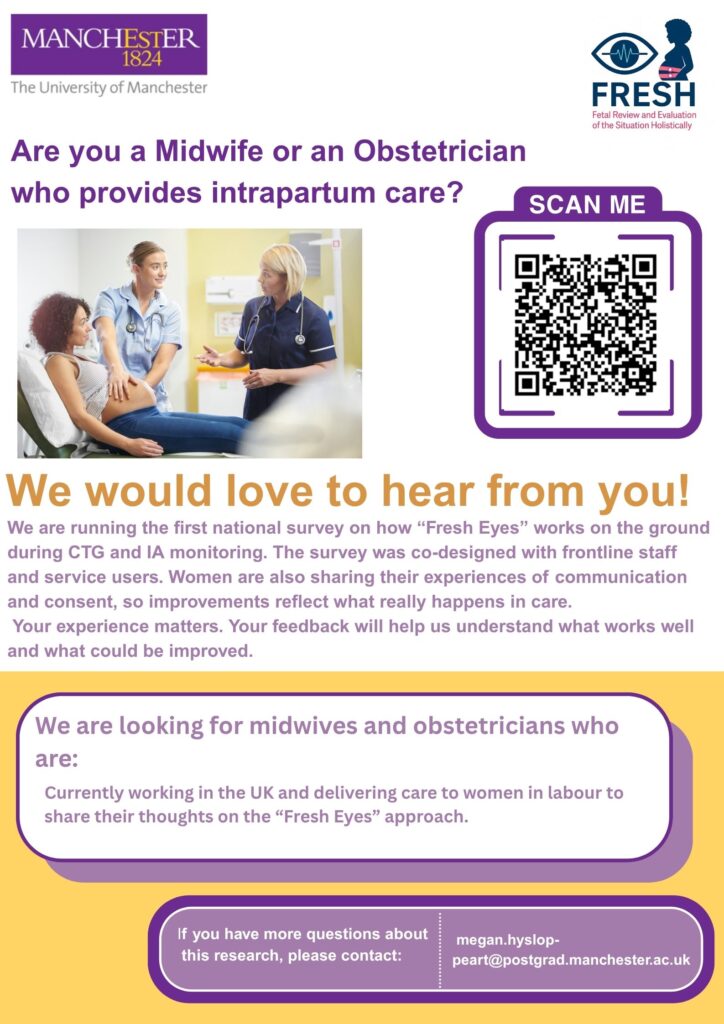
To address these gaps, I am conducting a national UK survey exploring how the “Fresh Eyes” approach is implemented and experienced across maternity services.
I am a midwife and Fetal Monitoring Lead at Manchester University NHS Foundation Trust, currently undertaking a master’s in clinical research at the University of Manchester. This study forms part of that work and focuses on improving both safety and women’s experiences of care.
The survey has been co-designed with women with lived experience, alongside midwives and obstetricians, to ensure it reflects what matters in real-world practice.
The study includes three groups:
- Fetal Monitoring Leads involved in implementation
- Frontline maternity staff using “Fresh Eyes” in daily practice
- Women and birthing people who experienced fetal monitoring during labour
Why this research matters now
Maternity services are under increasing pressure to demonstrate improvements in safety while also delivering personalised, compassionate care. National reports have repeatedly highlighted challenges in escalation, communication, teamwork, and listening to women (3-5).
Alongside this, there is growing recognition of the impact of birth trauma and the role that communication, involvement in decision-making, and feelings of safety play in shaping women’s experiences of care (5-7). Safety is not only defined by clinical outcomes, but also by how care is delivered and experienced.
There is also increasing awareness of inequities in maternity outcomes and experiences, particularly for women from Black, Asian, and minority ethnic backgrounds, those facing language barriers, and those experiencing social disadvantage. UK evidence consistently demonstrates disparities in maternal and perinatal outcomes, as well as differences in experience of care (8, 9). These disparities highlight the importance of understanding not only whether safety interventions are implemented, but how they are experienced across diverse groups.
The “Fresh Eyes” approach aims to support safer decision-making and shared understanding within teams. However, without evaluation, we risk assuming effectiveness without understanding how it works in practice, whether it achieves its intended purpose, or how it is experienced by women during labour.
This research seeks to explore:
- How “Fresh Eyes” is currently being used across the UK
- What supports or challenges its implementation
- How it influences teamwork and communication
- Whether it contributes to psychological safety for both staff and women
- How experiences of “Fresh Eyes” may differ across diverse populations
Understanding this is not only about fetal monitoring. It is about how maternity teams navigate uncertainty, how decisions are made and communicated, and how women experience safety interventions that are intended to support them.
How to take part
The survey takes approximately 10–15 minutes to complete and is intended to be anonymous. No identifiable information is collected, and responses cannot be traced back to individuals or organisations.
This study has received University of Manchester proportionate ethics approval and is being conducted as part of a master’s research project. The intention is not to assess individual practice, but to understand experiences and variation in care.
You can access the survey here:
https://redcap.manchester.ac.uk/surveys/?s=MK7HPWE8M7TMC3XW
The survey will close on 30th April 2026, and your contribution would be greatly valued.
If you are part of a professional network, or community group, I would be very grateful if you could also share this via your local communication channels, including social media, and parent groups, to help ensure a wide and diverse range of perspectives are represented.
If you have any questions, please contact:
Meg.Hyslop-Peart@mft.nhs.uk
Protocol: https://osf.io/w2k9e/overview
This article builds on a previously published blog for MIDIRS (10), adapted here to support wider engagement with this national study.
References
1. NHS, England. Saving babies’ lives: version 3.2, A care bundle for reducing perinatal mortality. 2025.
2. NICE. Fetal monitoring in labour, NG229. 2025.
3. Ockenden D. Findings, Conclusions and Essential Actions from the Independent Review of Maternity Services at The Shrewsbury and Telford Hospital NHS Trust. In: Care DoHaS, editor. 2022.
4. Kirkup B. Maternity and neonatal services in East Kent: ‘Reading the signals’ report. In: Care DoHaS, editor. 2022.
5. APPG. Listen to Mums:
Ending the Postcode Lottery on Perinatal Care. A report by The All-Party Parliamentary Group on Birth Trauma. 2024.
6. England. N. Three year delivery plan for maternity and neonatal services. In: England. N, editor. London2023.
7. MBRRACE-UK. Data brief (Jan 2026). 2026.
8. Knight M, Bunch K, Vousden N, Banerjee A, Cox P, Cross-Sudworth F, et al. A national cohort study and confidential enquiry to investigate ethnic disparities in maternal mortality. EClinicalMedicine. 2022;43:101237.
9. FiveXMore. Black Maternity Experiences Report 2025. 2025.
10. Hyslop-Peart M. ONLINE: MIDIRS. 2026. [1/4/2026]. Available from: https://rcm.org.uk/blog/2026/03/fresh-eyes-in-maternity-care/?fbclid=IwY2xjawQ6A_1leHRuA2FlbQIxMABicmlkETBpakZIQnJRdEs5eklOYWtlc3J0YwZhcHBfaWQQMjIyMDM5MTc4ODIwMDg5MgABHmJEJbJXwE0UgrjBgaGN88wU8amarPvuDFWetD0fk58UOToRJhLRLCGkQvLZ_aem_YvNkH3oC1m0EqAPwbabaOw.
Meg Hyslop-Peart
Midwife & Fetal Monitoring Lead, Manchester University NHS Foundation Trust; University of Manchester
Meg.Hyslop-Peart@mft.nhs.uk
April 2026