


The PREG-HEART study is helping to build the evidence base for better maternal cardiovascular care. Rebecca Jarman, Senior ARDT Research Midwife at South London Regional Research Delivery Network explores why the study matters and how midwives can support participation through everyday practice.
Cardiovascular disease (CVD) is a leading cause of maternal morbidity and mortality, both in the UK and globally. Recent findings from the MBRRACE-UK 2025 report reinforce the urgency of this issue, showing that cardiac disease accounts for more than one-third of pregnancy-related maternal deaths and is the leading cause of indirect maternal death.
It is well recognised that pregnancy induces substantial physiological cardiovascular changes, including increased blood volume, cardiac output and heart rate. However, whilst these changes are well tolerated in the majority of women, for some they may unmask or exacerbate underlying cardiac disease. Importantly, many women who die from cardiac causes during pregnancy do not have a known pre-existing diagnosis, emphasising the need for earlier identification and improved clinical vigilance. Furthermore, maternal mortality rates have not improved as anticipated and marked inequalities in maternal mortality persist with women from Black ethnic backgrounds and those living in areas of high deprivation, having notably higher risks of maternal mortality.
Against this backdrop, the PREG-HEART study represents an important step forward in detection, risk stratification and management of cardiovascular conditions in pregnancy.
What is PREG-HEART?
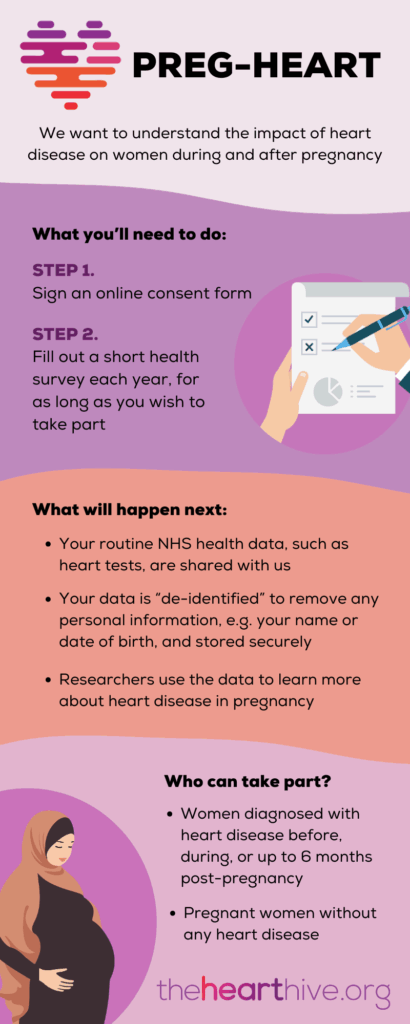
PREGnancy, HEART Health, and Cardiovascular Disease (PREG-HEART) launched in February 2026 and is a national, prospective, observational cohort and platform study designed to collect data on women’s cardiovascular health during and after pregnancy. Unlike traditional research studies that rely on recruitment through healthcare settings, or clinical / academic – led cohorts, PREG-HEART allows women to enrol independently online. Utilising this online, direct to patient recruitment approach, PREG HEART will enrol women with known CVD in pregnancy alongside healthy pregnant controls. Enrolled women will provide self-reported demographic and clinical data, consent to linkage with national health records for long-term follow up and optionally contribute blood, saliva or urine samples for laboratory research into the underlying biology of disease.
This model has the potential to widen access to research by removing some of the barriers associated with face-to-face recruitment and enabling women to participate in their own time. It also allows the study to reach a broader and more diverse population, including women with pre-existing cardiac conditions, women who are diagnosed with cardiac conditions during or shortly after pregnancy, and women with no known cardiac disease, who act as a vital control group.
By capturing data from across this wide spectrum, the study aims to build a clearer picture of how pregnancy impacts cardiovascular health over the longer term. PREG-HEART will deliver a scalable, diverse, and representative UK cohort, generate robust epidemiological evidence, and serve as a platform for biomarker discovery and clinical trials to inform clinical practice and health policy.
Why is this important for midwives?
Midwives play a pivotal role in recognising risk, identifying concerns, and supporting women throughout pregnancy and the postnatal period. They are often the first professionals to hear about symptoms such as breathlessness, palpitations, chest discomfort or fatigue—symptoms that may be attributed to pregnancy but may also indicate cardiac disease.
Research from PREG-HEART will strengthen midwifery practice by improving understanding of early indicators of cardiovascular risk, the long-term implications of pregnancy complications, and opportunities for prevention and follow-up care. This is particularly important because complications such as hypertensive disorders of pregnancy and peripartum cardiomyopathy are increasingly recognised as markers for future CVD (European Society of Cardiology, 2018).
Despite this, long-term follow-up after pregnancy complications is often inconsistent. Women may be discharged from maternity services without information about the implications for their future cardiovascular health, and opportunities for prevention may be missed. By generating evidence in this area, PREG-HEART has the potential to support more effective pathways between maternity services, primary care and cardiology.
Addressing inequalities in maternity care
Improving maternal cardiovascular outcomes is also a matter of equity.
Significant disparities remain in maternal mortality rates, with women from Black and Asian ethnic backgrounds and those living in deprived areas at greater risk of poor outcomes (Felker et al., 2025). Traditional research recruitment methods can unintentionally exclude these women, particularly when participation depends on regular contact with specialist services. By using a direct-to-participant approach, PREG-HEART offers an opportunity to widen participation and ensure that the data collected better reflects the diversity of the population receiving maternity care.
This is essential if future guidelines and services are to be equitable and responsive to the needs of all women.
The midwife’s role in supporting participation
Midwives have an important role in helping women become aware of research opportunities such as PREG-HEART.
This does not require major changes to practice. Often, it is the simple act of mentioning the study during routine antenatal or postnatal conversations, signposting women to information and the study website, and encouraging participation that makes the difference.
Because women can enrol independently, participation does not add burden to clinical services. Instead, it provides an opportunity for women to contribute to research in a way that is accessible and flexible.
Looking ahead
Pregnancy is increasingly recognised as a window into future health. Complications experienced during pregnancy can reveal an increased risk of future CVD, offering a crucial opportunity for early intervention. However, without robust evidence, services cannot be designed effectively to address this risk.
The PREG-HEART study is an important step towards closing this evidence gap. By improving our understanding of the relationship between pregnancy and cardiovascular health, it has the potential to shape future guidelines, improve continuity of care, and support better outcomes for women and families. For midwives, supporting research awareness is one practical way to contribute to this progress.
Every conversation matters
A brief mention of a study, a simple signpost to information, or a moment of encouragement could help build the evidence needed to improve care for generations to come.
If you are able to help raise awareness of the PREG-HEART Study within your Trust or local community please visit the PREG-HEART website where you will find study information and promotional materials. If you have further questions, please email the PREG-HEART study team preg-heart@imperial.ac.uk.
References
European Society of Cardiology (2018) ESC Guidelines for the management of cardiovascular diseases during pregnancy. European Heart Journal, 39(34), pp. 3165–3241.
Felker A, Pateel R, Kotnis R, Kenyon S, Knight, M (Eds) on behalf of MBRRACE-UK. Saving Lives, Improving Mothers’ Care Compiled Report – Lessons learned to inform maternity care from the UK and Ireland Confidential Enquiries into Maternal Deaths and Morbidity 2021-23. Oxford: National Perinatal Epidemiology Unit, University of Oxford 2025. DOI: 10.5287/ora-4javr692x
National Institute for Health and Care Excellence (NICE) (2021) Antenatal care. London: NICE.
Author biography
Rebecca Jarman is a midwife with over 30 years of clinical experience. She is currently working as a research midwife and is a research champion for reproductive health and childbirth with the NIHR South London Regional Research Delivery Network. She has a specialist interest in maternal cardiology, equitable maternity care, and improving long-term cardiovascular outcomes for women through research and clinical collaboration. Rebecca is a member of the NIHR-British Heart Foundation Cardiovascular Partnership Maternal Cardiovascular Health Theme
April 2026
Rebecca Jarman, Senior ARDT Research Midwife, South London Regional Research Delivery Network