

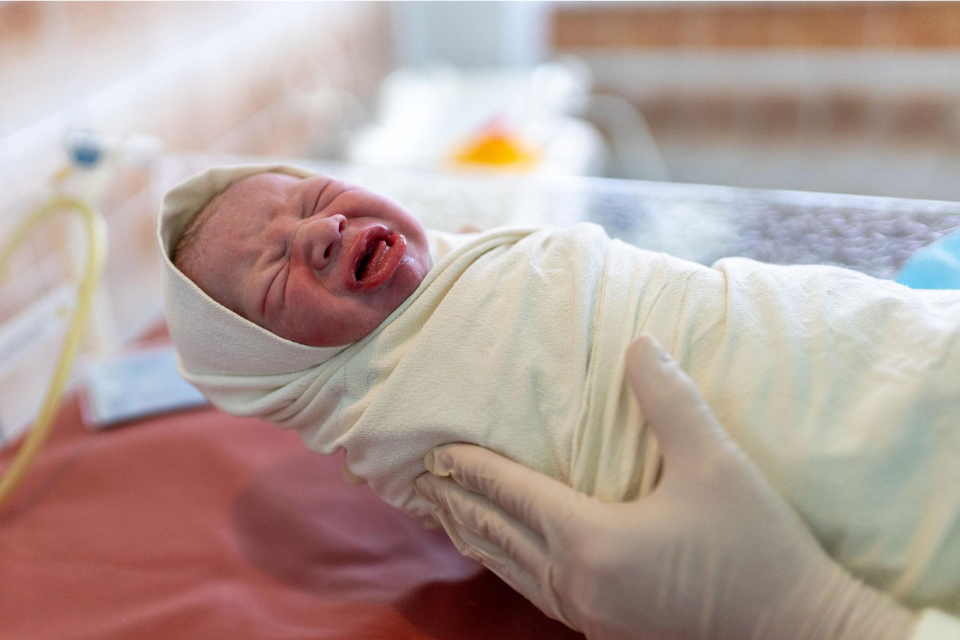
In this article Dr. Laura Goodwin explores the critical challenge of keeping babies warm when birth occurs unexpectedly outside the maternity care system. Drawing on pioneering research into prehospital births, the article highlights the risks of neonatal hypothermia, the barriers faced by ambulance clinicians and emergency call handlers, and the practical system-wide changes now improving outcomes for newborns before they reach hospital care. It also examines the growing importance of collaboration between ambulance and maternity services to ensure safer, more consistent care for babies born before arrival.
Babies born before arrival at hospital, outside of planned maternity care, present a very different set of challenges to those born in planned settings. When birth happens outside of hospital without a midwife present, the usual structures of maternity care are not there. In those moments, care often falls to ambulance clinicians, call handlers, and whoever is present at the scene. One of the most immediate risks for these babies is hypothermia.
Neonatal hypothermia is well recognised as a contributor to poor outcomes. But in the prehospital environment, it can be difficult to prevent. Births may happen unexpectedly, in suboptimal conditions, with limited equipment and competing priorities. Despite this, there has historically been very little focus on how thermal care is managed before arrival at hospital.
Our research started with a simple question: how is newborn temperature measured and managed in the prehospital setting? Early work exploring paramedic practice in the South West of England found that neonatal temperature was only being recorded in a very small proportion (2.7%) of cases and identified several practical barriers to measurement and management (Goodwin et al., 2022). Of those babies where a temperature was recorded, the majority (72%) were hypothermic. This was a concerning finding; if temperature is not routinely measured, it becomes much harder to recognise hypothermia and respond to it.
Further research was then funded by Health Innovation South West, exploring which babies are most at risk and identifying opportunities to improve care at a system level. This included examining hospital data in the South West to understand patterns of birth before arrival and inequalities, as well as analysing the advice given to parents during 999 calls about prehospital birth (Goodwin et al., 2024). This work suggested that around 1 in 3 (35%) babies were arriving at hospital hypothermic, with some classified as severely hypothermic and requiring urgent warming. It also identified gaps in the advice provided during emergency calls, particularly in relation to early thermal care, indicating clear opportunities to strengthen support at the very start of the care pathway.
From there, the focus shifted to working with the local ambulance service (South Western Ambulance Service NHS Foundation Trust; SWASFT) and national call-handling organisations to address these gaps in practice. The emphasis was on making practical changes across the system. This included updates to 999 call handler advice (via NHS Pathways and International Academies of Emergency Dispatch), so that parents or bystanders could be supported to keep babies warm from the moment of birth. There were also changes within SWASFT affecting equipment, training and documentation, with a greater emphasis on both thermal care and temperature recording (Health Innovation South West, 2024). These are relatively small shifts individually, but together they start to build a more consistent approach.
Recently, we explored what difference these changes might be making in practice. At a headline level, we have seen a reduction in the proportion of babies arriving at hospital with hypothermia, from around one in three to around one in six (University of the West of England, 2024). While there is more to understand about how and why this change has occurred, it suggests that relatively simple, system-level interventions can make a meaningful difference.
For midwives, this has important clinical implications. Babies born before arrival will usually enter maternity care shortly after birth, often via transfer into hospital. By that point, key elements of early care have already taken place in the prehospital setting. Understanding what has (and has not) happened before arrival can help to inform ongoing care and decision-making. Ambulance clinicians are often working in isolation, without immediate access to midwifery support, and with very limited time to make decisions, which makes effective communication between services particularly important.
There is also a wider context to consider. Babies born before arrival are not evenly distributed across the population. Previous work suggests that these births are more common in areas of higher deprivation and may be associated with other factors such as late booking and safeguarding concerns (Goodwin et al., 2024). That makes it even more important that the care provided in these situations is as consistent and effective as possible.
This is still an evolving area of research and knowledge transfer. This work forms part of a wider programme of research funded by Health Innovation South West, and further findings will be reported in peer-reviewed publications. But there are some clear messages already.
First, thermal care in the prehospital setting matters, and it is something that can be improved. Second, relatively small changes across a system — in call handling, equipment, training and documentation — can combine to have a real impact. And third, this is a shared space between services. Improving outcomes for these babies depends on how well ambulance services and maternity services understand and support each other’s roles.
There is a clear opportunity here for stronger collaboration. This might include joint training, shared guidance, or simply greater awareness of what happens before a baby reaches maternity care. For those involved in education, there is also scope to ensure that prehospital birth is not overlooked.
Building on this work, we are now starting to explore the challenges associated with preterm babies born before arrival, where the risks and complexities are often even greater. This is an area that remains under-researched, particularly in the prehospital setting.
If you have experience of preterm birth in the prehospital context – whether as a midwife, ambulance clinician, or through personal experience – those insights would be valuable in helping shape future work in this area. Please contact me for more information about getting involved: Laura.Goodwin@uwe.ac.uk
References:
Goodwin, L. et al. (2022) Inequalities in birth before arrival at hospital in South West England. Emergency Medicine Journal, 39(11), 826. (https://bmjopen.bmj.com/content/14/4/e081106.abstract)
Goodwin, L. et al. (2024) Temperature measurement of babies born in the pre-hospital setting. BMJ Open, 14(4), e081106. (https://emj.bmj.com/content/39/11/826.abstract)
Health Innovation South West (2024) Research and training drives changes to South West emergency service for babies born outside of hospital. (https://healthinnovationsouthwest.com/blog/2024/05/28/research-and-training-drives-changes-to-south-west-emergency-service-for-babies-born-outside-of-hospital/)
University of the West of England (2024) Study finds improvements in neonatal hypothermia outcomes following prehospital care changes. (https://www.uwe.ac.uk/news/dr-laura-goodwin-study)
Links:
International Academies of Emergency Dispatch: https://www.emergencydispatch.org/home
Health Innovation South West: https://healthinnovationsouthwest.com/
Dr Laura Goodwin: https://uk.linkedin.com/in/lkgoodwin
Dr Laura Goodwin, Associate Professor in Emergency Care, University of the West of England
May 2026