
Access to clear, practical information can make a vital difference to outcomes in pregnancy. In this article, Heidi Eldridge, CEO and Founder of MAMA Academy, together with Amisha and Nik Adhia of Action for Accreta, explore how the MAMA Academy Pregnancy Passport is helping parents recognise warning signs, advocate for their care, and navigate maternity services with confidence. Through personal experience, evidence of improved outcomes, and a focus on reducing health inequalities, they highlight how empowering families with knowledge can save lives and improve maternity safety across the UK.
Every year in the UK, families experience the devastating and entirely preventable loss of a baby. At MAMA Academy, we believe that informed, empowered parents are one of the most powerful tools we have in the fight against preventable perinatal death. That is why the MAMA Academy Pregnancy Passport is at the heart of everything we do and why, when Heidi heard Amisha and Nik’s story and has been an early charity partner for Action for Accreta, it is highly relevant on the power of putting information in the hands of patients.
What Is the Pregnancy Passport?
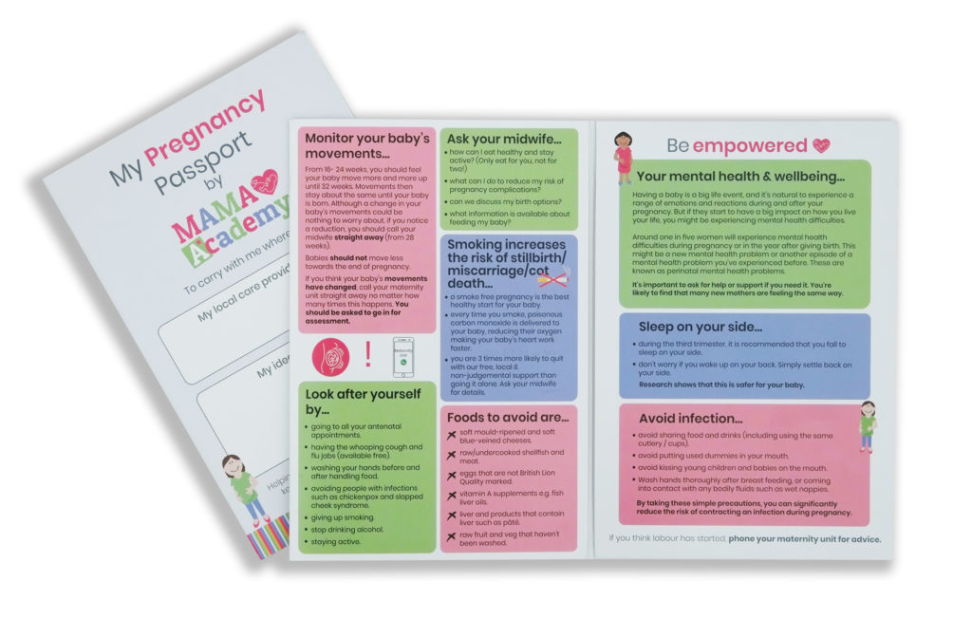
The MAMA Academy Pregnancy Passport is a practical, portable resource designed to be carried by expectant parents throughout their pregnancy. It equips families with the knowledge and confidence to recognise the signs and symptoms that matter and, crucially, to act on them without delay.
The Passport covers:
- Reduced fetal movements: an important warning sign parents must never ignore
- Signs of infection, including sepsis, which can deteriorate rapidly if left untreated
- Early warning signs of pre-eclampsia, a leading cause of maternal and perinatal death in the UK
Each Passport includes key contact numbers so parents know exactly who to call and when, removing hesitation and delay at the moments that matter most.
A Passport That Stayed With Us
When we first connected with Amisha and Nik Adhia, from Action for Accreta, a national patient safety campaign born from Amisha’s near-fatal experience with Placenta Accreta Spectrum (PAS), one detail in particular stood out.
They had kept their Pregnancy Passport from their first pregnancy.
Not as a memento. As a tool. When Amisha became pregnant again, that Passport was there: a portable record of key medical information that could be handed to a new provider without having to explain everything from scratch, a page of contact numbers that meant they knew exactly who to call and when, a quiet reminder that they had the right to ask questions and expect answers. In a maternity journey that had already taught them, devastatingly, what happens when warning signs go unrecognised, having something so simple, a document that travels with you, that speaks for you when the system feels too complex to navigate alone, mattered more than they had expected.
“It sounds like a small thing,” Amisha reflects. “But when you’ve been through what we have, knowing you can transfer your notes between providers, knowing the right number is on the page in front of you rather than buried in a system somewhere, that’s not small. That’s the difference between hesitating and acting.”
It is exactly that insight, the practical, human reality of what the Passport does, that led Heidi to reach out to Amisha and Nik, and to Heidi’s decision to formally support the Action for Accreta campaign.
Empowering Advocacy: For Every Parent
One of the most powerful aspects of the Pregnancy Passport is its role as an advocacy tool. Navigating the NHS during pregnancy can feel overwhelming, and parents — particularly those from marginalised communities, can feel uncertain about speaking up or asking for different care. The MAMA Academy website includes specific prompts to help parents articulate their concerns clearly and confidently to healthcare professionals.
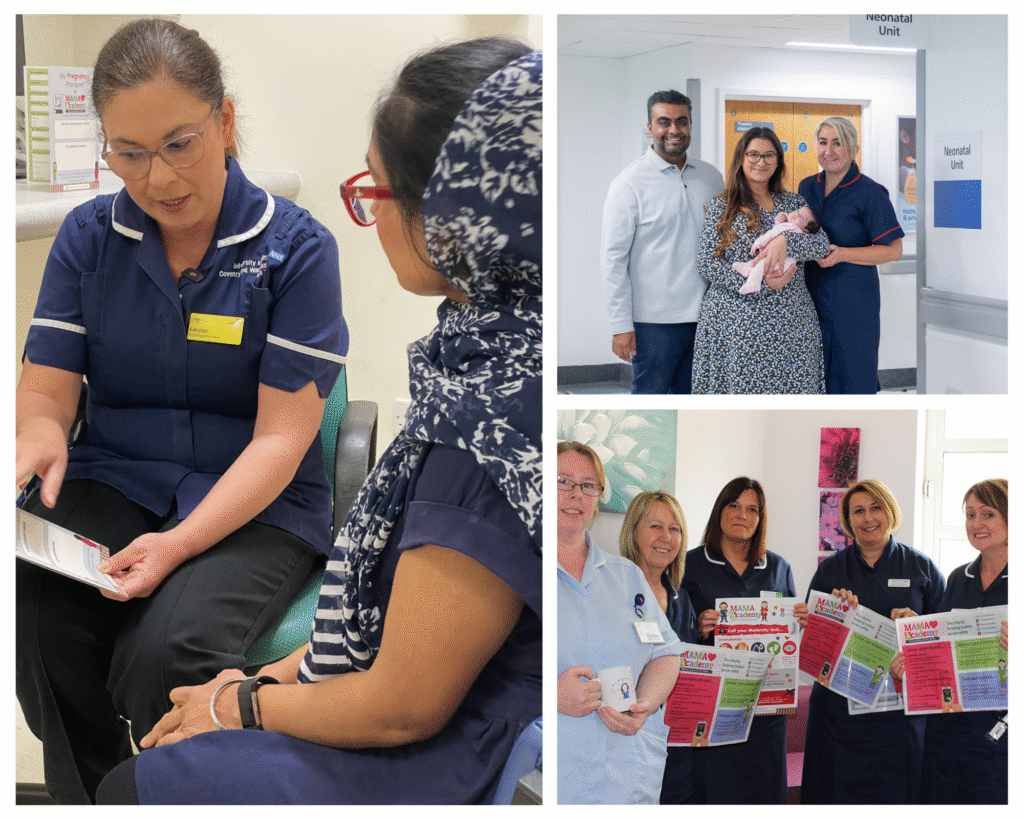
We often hear from dads and partners that the Passport has been a lifeline. They describe referring back to it during moments of concern and using it to encourage their partner to contact the maternity unit. In a system that can sometimes feel complex and difficult to navigate, the Passport helps to build and strengthen the relationship between parents and their midwife, creating a shared language and a clearer pathway to care.
“As a partner, you become the one trying to hold everything together between appointments , making sure the right information reaches the right people, that nothing gets lost in the gaps between providers,” Nik adds. “The Passport was part of that. Having the contact numbers to hand, a way to carry our notes from one appointment to the next, those small things matter more than you’d expect when you’re navigating a system that doesn’t always join the dots for you.”
The downstream power of that advocacy can be profound. Action for Accreta began with a family who survived a catastrophic birth experience involving undetected Placenta Accreta Spectrum, and channelled it into systemic change: Guardian front-page coverage, ITV News primetime reporting, 22 Parliamentary Questions in Hansard, and a commitment from the Royal College of Obstetricians and Gynaecologists to update its clinical guidelines this summer to reflect atypical presentations and non-previa PAS. Their economic modelling identified £37.3 million in avoidable acute spend and a 54:1 return on investment for earlier detection. The campaign now represents over 100 families.
None of that would have been possible without the foundational belief that their experience was worth speaking about, that the system could be held to account. That belief has to begin somewhere. Often, it begins with a parent who felt equipped enough to ask.
Reducing Health Inequalities
We know that health inequalities in maternity care remain a persistent and urgent challenge. The MAMA Academy Pregnancy Passport is designed with equity at its core. Embedded QR codes link directly to the MAMA Academy website, which is translatable into more than 100 languages, ensuring that families from ethnic minority backgrounds or those with limited English can access the same life-saving information as everyone else.
This matters acutely for conditions like Placenta Accreta Spectrum, which is increasingly understood to present atypically in women who do not fit the classical risk profile and who are therefore more likely to be dismissed or misdiagnosed. Through Action for Accreta, Amisha and Nik have been working specifically on this gap, advocating for updated clinical guidance to capture non-praevia PAS presentations that current protocols routinely miss. Greater health literacy, earlier in pregnancy, creates the conditions in which families can challenge what they are told, and sometimes that challenge saves lives.
The Passport also includes space to record essential medical information in written form, ensuring that critical details are always available, even when digital records cannot be accessed in an emergency. For families like Amisha and Nik’s, moving between providers and settings, that written record is not a backup. It is the thread of continuity that the system does not always provide.
The Evidence: A Measurable Impact on Stillbirth Rates
The Pregnancy Passport does not just claim to save lives, the data shows it is doing exactly that. An initial audit found that 91% of NHS Trusts reported a moderate to significant reduction in stillbirth rates following the introduction of MAMA Academy resources.
Derby and Burton NHS Trust provides a particularly compelling example. After beginning distribution of the Pregnancy Passport in 2024, the Trust recorded a 38% reduction in its stillbirth rate compared to the previous year. These are not just statistics, they represent families who went home with their babies.
The Financial Case for Investment
The human cost of a stillbirth is immeasurable. But policymakers and NHS leaders must also understand the significant financial burden. Each stillbirth costs the NHS approximately £4,191 in direct costs alone, and that figure does not account for the far greater costs of litigation, inquiry, and long-term support.
At a unit cost of just 75p per Passport, the investment case is straightforward: preventing just one stillbirth represents a net saving of £3,309 to the NHS. Compounding this, providing 10,000 Pregnancy Passports of Wellbeing Wallets annually would cost £7,500 and pays for itself by reducing three stillbirths.
The economic logic is echoed across the wider maternity safety landscape. Action for Accreta’s independent modelling, drawing on NHS National Cost Collection data, identified £37.3 million in avoidable acute spend attributable to late or missed PAS diagnosis, with a 54:1 return on investment for a nationally coordinated screening and awareness programme. The pattern is consistent across conditions: investment in informed parents and earlier identification consistently outperforms the cost of crisis intervention. At scale, the financial argument for universal distribution of the Pregnancy Passport is not just compelling, it is unanswerable.
Join Us
MAMA Academy is committed to ensuring that every family in the UK has access to the information they need to stay safe in pregnancy. Heidi’s decision to support the Action for Accreta campaign reflects our shared conviction: that what happens to one family, if we listen to it properly, can change things for thousands of others.
Amisha and Nik kept their Pregnancy Passport because it worked. Because having the right information, in the right format, at the right moment, numbers to call, space to record, language to use, gave them something to hold onto. That is what this campaign has always been about. And it is why we are proud to be building it together.
If you would like to find out more about distributing the Pregnancy Passport in your Trust, or to explore how MAMA Academy can support your maternity teams, please visit www.mamaacademy.org.uk or get in touch directly.
To find out more about the Action for Accreta campaign, access the UK PAS Specialist Centres List, or follow the campaign’s parliamentary and clinical work, visit www.actionforaccreta.org.
About MAMA Academy
MAMA Academy is a UK-based safer pregnancy and maternity charity. Our Pregnancy Passport, Wellbeing Wallets, and associated resources are used by NHS Trusts across the country to support families and reduce preventable perinatal death.
About Action for Accreta
Action for Accreta is a national patient safety campaign started by Amisha and Nik Adhia following Amisha’s near-fatal experience with Placenta Accreta Spectrum (PAS). Backed by 12 leading maternity and neonatal charities, the campaign has secured the first ever NHS Official List of PAS centres in England and a commitment from RCOG to update clinical guidelines, so that every family affected by PAS is seen, heard, and protected.