

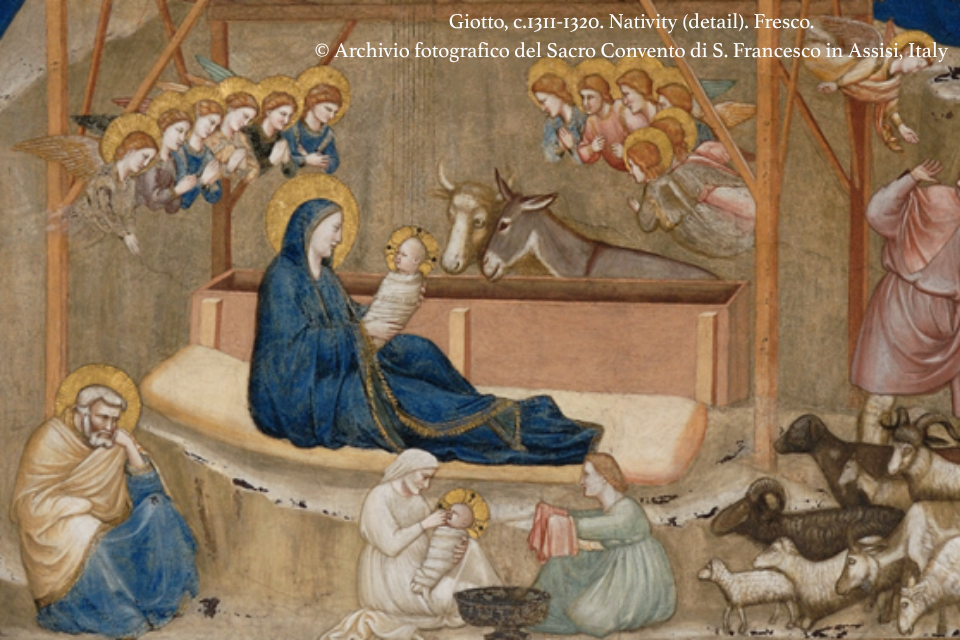
This article uncovers the overlooked presence of midwives at the birth of Jesus, focusing on the legendary figures of Salome and Zebel. Drawing on art, early Christian texts and personal research, Jane Salvage, Visiting Professor at Kingston University explores how these women were once central to nativity stories yet later marginalised or erased. Blending history, theology and midwifery practice, Jane invites readers to reconsider familiar narratives and recognise the enduring significance of women’s roles in both religious tradition and contemporary care
Every Christmas, I hope someone will send me a card showing Mary’s two midwives.
‘What midwives?’, I hear you thinking.
Take a good look at this well-known painting, especially the two women centre front, who have bathed the baby, swaddled him and handed him back to his mother. They are the two legendary midwives who cared for Mary and Jesus and became his first followers – Salome and Zebel. They have their own stories to tell, of doubt, duty, punishment, despair and redemption.
Salome and Zebel’s extraordinary story is often forgotten today, but it has been known among millions of Christians for nearly 2000 years. The midwives aren’t mentioned in the Bible’s New Testament, but they star in a strange, disturbing tale that was first recorded around the year 150. It says that Joseph brings them to a cave outside Bethlehem where the family is sheltering. But they arrive too late – poor Mary has given birth alone.
Zebel is an instant believer that baby Jesus is the long-awaited Messiah, but Salome isn’t so sure. Claims of virgin births weren’t uncommon in those days. So, like every good midwife, she rolls up her sleeves to do the post-partum examination. This doesn’t go well, to say the least, and she is punished, but then redeemed by baby Jesus’ first miracle. This ancient Legend of the Doubting Midwife made Salome the most famous midwife ever.

Duccio di Buoninsegna, 1308-1311. The Nativity with the Prophets Isaiah and Ezekiel (detail). Predella panel, Maesta. Courtesy National Gallery of Art, Washington, USA.
You can see Salome and Zebel in altarpieces, oil paintings, frescoes and sculptures, located in churches, museums and art galleries across Europe and beyond. They bath the holy baby, wrap him in swaddling clothes and chuck him under the chin. Other legendary midwives are often shown at the births of Mary herself, St John the Baptist and many other saints.
Salome and Zebel also featured down the centuries in sermons, plays, poems and Christmas carols. Their personal dramas bring a human touch to the extraordinary events unfolding around them. They also carry heavy symbolic freight linked with fierce theological debates.
Later, the midwives were frequently written out of art history through ignorance or misogyny. Even scholars who noticed them often failed to acknowledge them as midwives. Instead they were described as servants, handmaidens, shepherdesses, bystanders, lowly figures, decoration, figures put there to fill the space, and unnamed women. Until the 1980s, nearly all these experts were men. Their descriptions puzzled, annoyed and goaded me into reading widely and deeply while looking out for sightings.

Unknown makers, c.1150. Nativity, detail. Mosaic.
Church of S. Maria dell’Ammiraglio, Palermo, Sicily. Photo Jane Salvage
I must confess, though, that I too had never noticed them before hearing about them at an art history lecture in Florence, Italy, some years ago – despite all my years of campaigning to highlight and improve the public image of midwives and nurses. We see what we are conditioned to see. After that lecture, I embarked on a voyage of discovery alongside my busy career in nursing and midwifery.
My research tracked Salome and Zebel from the first mention of Mary’s pregnancy in the New Testament. I realised that they not only cared for baby Jesus, but also stayed with the holy family – there are paintings of them on the Flight to Egypt and beyond. I encountered innumerable other people down the ages who loved, feared, imagined or portrayed them. Countless artists, makers, writers, poets, composers, singers, parish priests, archbishops, popes, monks and nuns all remembered and commemorated them.
Images of Salome and Zebel, and of many other midwives at the births of many saints, were part of the Christian tradition across many centuries and countries. They appear from the second century onwards in the Roman Catholic, Protestant and Eastern Orthodox faiths and in folklore, but had largely disappeared from western European art and culture by the late 18th century. This decline coincided with the gradual takeover of midwifery, always a female profession, by the new ‘man-midwives’ and then obstetricians.

Ottaviano Nelli, 1424. Nativity of Jesus. Palazzo Trinci, Foligno, Umbria, Italy.
Thanks to the Comune di Foligno.
Friends sent me photos: ‘Is this one of them?’ My work takes me to many different countries, and I always ask midwives whether they know of them. In countries with strong Roman Catholic or Eastern Orthodox traditions, they often say ‘Yes! Of course!’
The nativity midwives, and what people said about them, changed my ways of seeing and understanding. I viewed them through the lens of my long career in global nursing and midwifery, and my perspective as an atheist trying to understand the enduring appeal of Christianity. My research restores this missing piece of art history: as Virginia Woolf said, ‘Women’s history has to be read into the scene of its own exclusion – invented – both discovered and made up.’
My quest, originally a hobby, eventually led me to lecture and then write two books about them. The Midwife’s Book of Hours is a short hardback book, with many gorgeous illustrations. The Midwives’ Gospel: The forgotten women at the birth of Jesus is a full-length e-book. They blend the politics of health and midwifery, history, theology, creative non-fiction and memoir. Imagining what Salome and Zebel might have experienced, I give voices to them and the countless other women who prayed to them, saw and commissioned pictures of them, watched them in miracle plays, and heard about them in sermons.
Bringing these often marginalised or ignored nativity midwives into this story – past and present, fictional and real – is another way of hearing and heeding the voices of mothers and midwives. My research contributes to the debate about women’s roles as carers and leaders. At a time when midwifery globally is in crisis, and one million more midwives are needed, can we afford to forget the most famous midwives of all?
Contact me at janesalvage@me.com or find out more at my website, janesalvage.com.
May 2026
Jane Salvage, Visiting Professor, Kingston University, London, United Kingdom
